1. The Motion-to-Photon Constraint in Spatial Computing
Spatial computing encompasses augmented reality (AR) optical passthrough, mixed reality (MR) camera video passthrough, and immersive virtual environments. Unlike desktop or smartphone screens where a frame rendering delay merely feels sluggish, spatial computing binds visual display directly to the human vestibular system.
The critical engineering threshold is "motion-to-photon" latency—the exact elapsed duration from physical head movement (sensed by an IMU) to the updated display photons reaching the user's retina. If motion-to-photon latency exceeds 15 to 20 milliseconds, the mismatch between inner ear balance canals and retinal cues triggers severe vestibular disorientation and nausea. Sustaining sub-15ms throughput requires custom sensor-processing hardware pipelines that bypass standard operating system compositor bottlenecks.
2. Input Modalities: The Flaws of Mid-Air Gestures
Science-fiction depictions commonly portray users manipulating complex 3D holographic windows using dramatic, broad mid-air hand gestures. In production reality, mid-air interaction fails due to fundamental biomechanics:
- Gorilla Arm Syndrome: Elevating the human forearm without elbow or wrist support induces severe deltoid and trapezius fatigue within two to four minutes of continuous use.
- Lack of Tactile Haptic Confirmation: When tapping a physical keyboard or mechanical button, nerve endings in the finger detect contact resistance instantly. Mid-air "air-tapping" provides zero kinetic feedback, forcing the user to rely entirely on visual or acoustic confirmation and multiplying error rates.
- Micro-Gesture Alternatives: Sustainable spatial interaction relies on subtle micro-gestures performed with the hands resting comfortably in the user's lap. Optical hand-tracking algorithms detect micro-pinches between thumb and index finger, requiring minimal muscular exertion.
3. Voice and Multimodal Ingestion Realities
Continuous conversational voice interfaces are often promoted as the natural replacement for graphical user interfaces. While voice is convenient for rapid command execution ("set timer for 12 minutes") or narrative dictation, it exhibits severe structural limitations as a primary navigation modality:
Voice is strictly sequential. A human can visually scan a graphical table of 50 structured rows in three seconds, immediately isolating an anomaly. Listening to a synthetic voice recite the same 50 rows requires over two minutes of tedious auditory consumption. Furthermore, voice input fails in shared environments due to ambient acoustic interference and absolute privacy loss; operators cannot dictate confidential medical, legal, or financial information inside open workplaces or public transit.
4. Cognitive Load and Attention Fragmentation
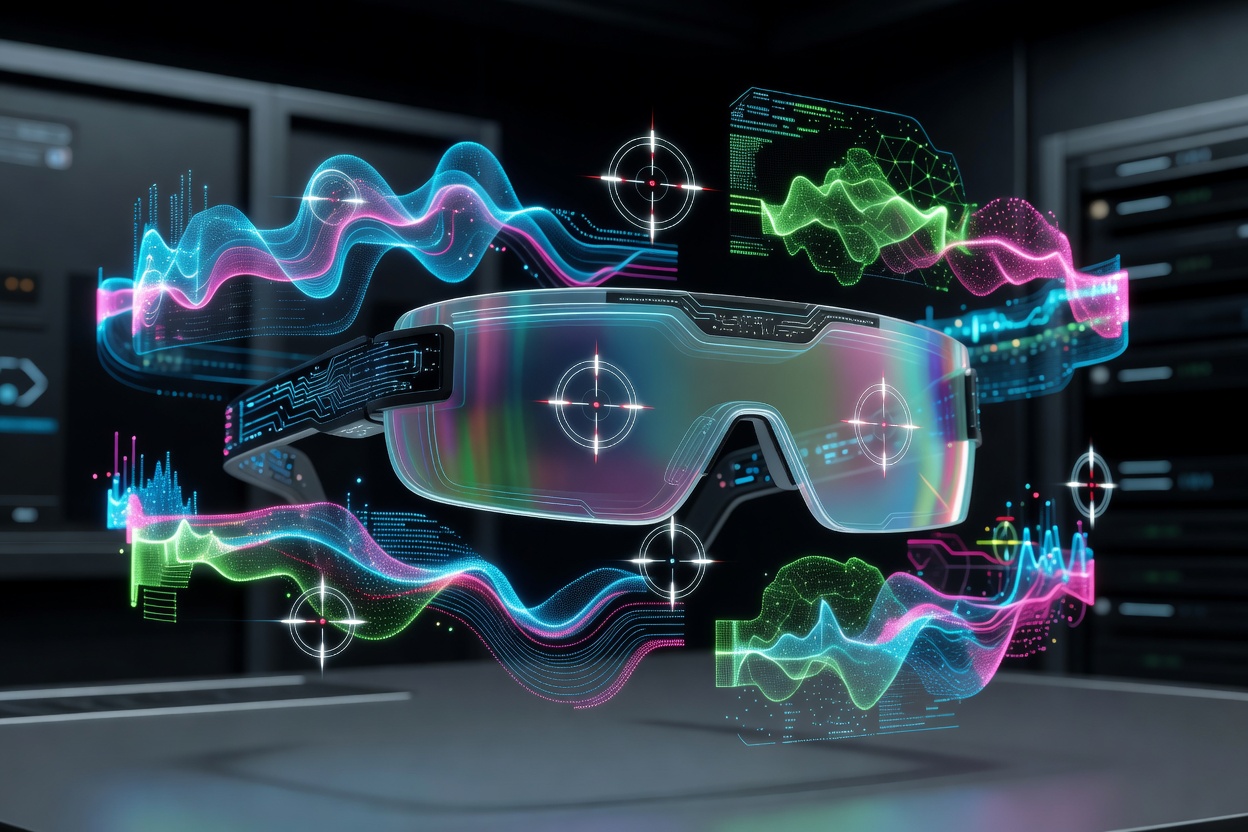
An interface that is technically capable of overlaying real-time notifications, telemetry vectors, and contextual labels directly into an operator's visual field is not necessarily usable. Excessive spatial augmentation introduces severe visual clutter, masking physical safety hazards and driving cognitive saturation.
High-performance interface design requires aggressive context filtering. The machine must display data only when explicit task conditions require it, prioritizing calmness, contrast legibility, and high-contrast typography over decorative visual density. The most effective interface is frequently the one that remains completely invisible until an anomaly demands operator intervention.
What to Watch
Surface electromyography (sEMG) wristbands detecting motor-neuron electrical signals before fingers move, wave-guided diffractive optics with high optical transparency, and neural audio noise gating.
Good For
Hands-free industrial repair manuals, complex surgical spatial navigation, immersive flight training simulation, and zero-reach spatial monitor multitasking.
What to Know
Mid-air hand gestures induce severe muscular fatigue within minutes. Motion-to-photon latency must remain below 15ms. Voice interfaces are sequential and fail in shared acoustic spaces.
Questions Regarding Interface Architecture?
Inquire directly with our team regarding spatial ergonomics, eye-tracking precision, or voice interaction integration.
Contact Technical Desk