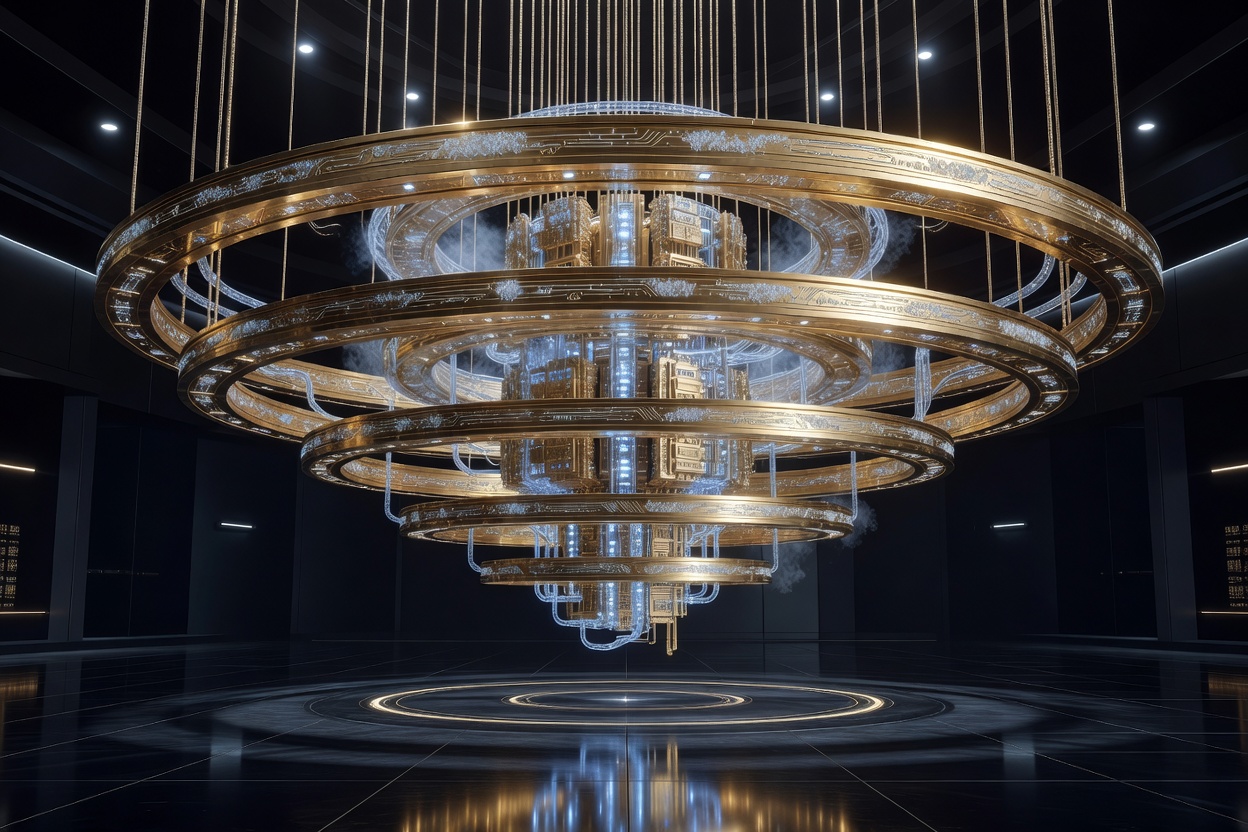
1. Beyond the Monolithic CPU: Heterogeneous Specialization
For four decades, general-purpose central processing units (CPUs) benefited from Dennard scaling and predictable clock rate gains. As silicon gate dimensions approached single-digit nanometers, leakage current and thermal dissipation halted raw frequency scaling. Computing architecture responded by fragmenting the processing die into specialized accelerators.
Modern compute workloads are rarely handled by homogeneous cores. Instead, a modern system-on-chip (SoC) coordinates control logic on scalar CPU cores, delegates dense parallel matrix multiplications to vector GPUs, routes token tensors to dedicated NPUs, and processes signal filtering on DSP blocks. While peak theoretical throughput increases drastically, software development becomes exponentially more complex, requiring sophisticated runtime schedulers to synchronize memory coherence across disparate execution units.
2. The Physics of Data Movement and Near-Memory Computing
The defining limitation of modern computing is not arithmetic capacity (FLOPs), but data transport latency and energy. Moving a 64-bit operand across eight inches of PCB copper trace consumes significantly more energy than computing an addition on that operand inside the arithmetic logic unit (ALU).
To alleviate this "memory wall," architects are shifting to 2.5D and 3D stacking techniques. High-Bandwidth Memory (HBM) packages place DRAM dies directly above or adjacent to the logic silicon using microscopic silicon interposers and through-silicon vias (TSVs). Processing-in-Memory (PIM) goes further by embedding primitive arithmetic elements directly into the memory dies, executing filtering, aggregation, and activation operations without ever moving bits across the primary system bus.
3. Quantum Computing: Practical Scope and Decoherence Realities
Quantum computing represents a distinct physical paradigm utilizing quantum mechanical superposition and entanglement. However, public discussions frequently mischaracterize quantum processors as universally fast replacements for classical computers.
Quantum computing provides exponential theoretical acceleration for specific computational problems: discrete logarithm factorization, chemical Hamiltonian simulations, and certain combinatorial optimization spaces. For general sequential code, file operations, web serving, and image rendering, quantum computers offer no operational advantage. Furthermore, physical qubits suffer from thermal noise and decoherence, requiring cryogenic dilution refrigerators operating fractions of a degree above absolute zero. Real-world commercial utility hinges on quantum error correction (QEC), which demands hundreds or thousands of physical qubits to sustain a single fault-tolerant logical qubit.
4. Cloud Hyperscale vs. Distributed Edge Architecture
The tension between centralized data centers and distributed edge nodes involves immutable physical constraints: latency, network bandwidth costs, and regulatory data sovereignty.
- Centralized Cloud Strengths: Massive power provisioning, dense water-cooling loops, centralized hardware maintenance, and statistical multiplexing of huge compute clusters.
- Edge Computing Strengths: Zero transit round-trip latency (sub-5 millisecond response times required for industrial machine safety and spatial tracking), immunity to backhaul fiber cuts, and compliance with data residency mandates.
Architectural selection requires balance: training massive foundation models will remain centralized due to the need for terabit-per-second interconnects between thousands of GPUs, while real-time inference and safety-critical state evaluation must run on ruggedized edge silicon directly beside the actuators.
What to Watch
Compute Express Link (CXL) memory pooling, co-packaged optics (CPO) replacing copper interconnects inside server racks, and fault-tolerant logical qubit error correction milestones.
Good For
High-density simulation, near-sensor signal aggregation, deterministic industrial automation nodes, and highly parallelized tensor transformations.
What to Know
Data locomotion consumes more power than calculation. Quantum computers will act as specialized co-processors for narrow algorithmic domains, not universal replacements for silicon CPUs.
Have Questions On Compute Infrastructure?
Contact our technical editorial desk to submit questions regarding heterogeneous architecture benchmarks or edge cluster deployment models.
Contact Technical Desk